Architecting Enterprise Intelligence: The Definitive Blueprint for Scalable BI Frameworks
 0|
0| 0
0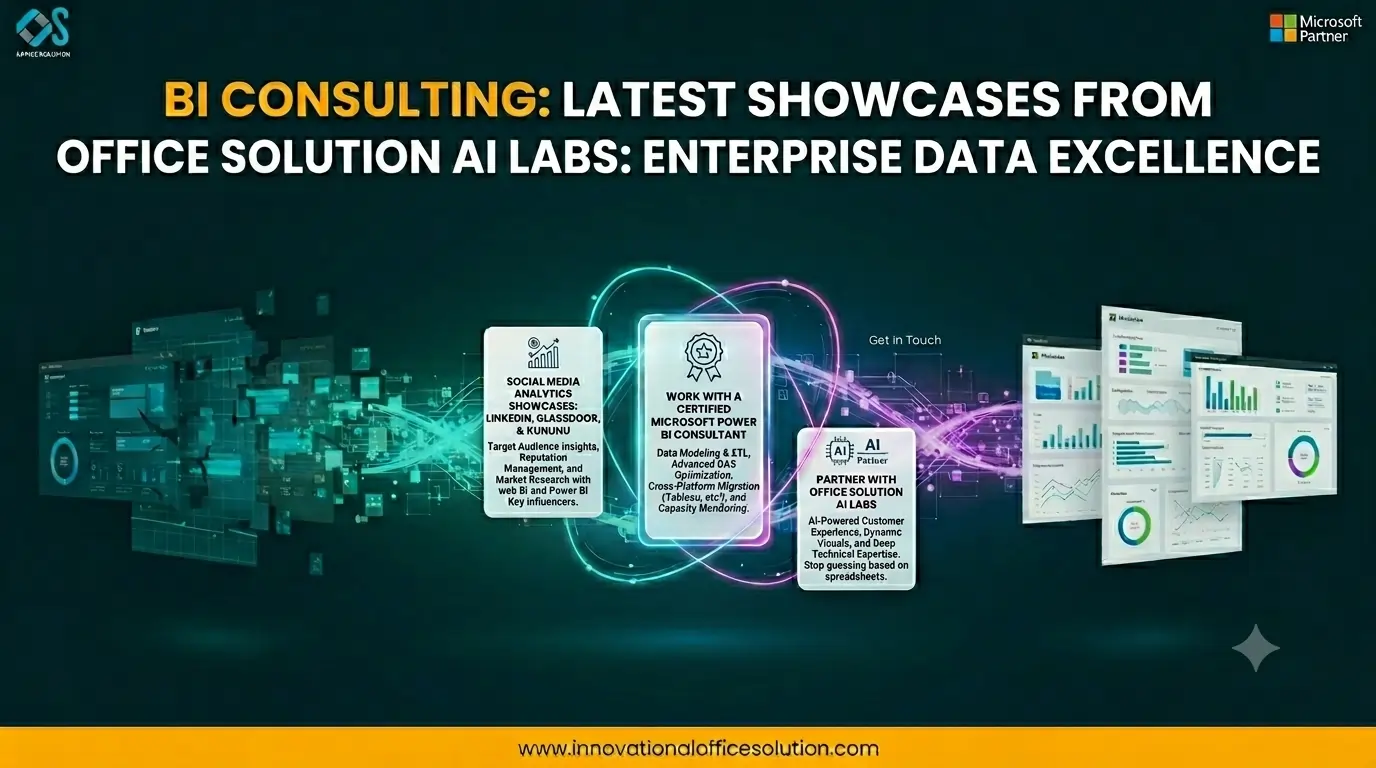
Table of Contents
Modern enterprises do not suffer from a lack of data; they are overwhelmed by its chaotic velocity and fragmentation. Operational efficiency drops when decision-makers are forced to rely on unverified spreadsheets, separate database ecosystems, and conflicting departmental metrics. When executive leadership debates the accuracy of foundational revenue numbers during an annual review, the primary issue is not visual formatting. The breakdown lies entirely within the underlying data model.
Transforming raw, distributed enterprise information into actionable corporate strategy requires a disciplined shift from reactive reporting to a unified analytical infrastructure. Without an intentional, engineering-driven data strategy, data volume expands to create significant processing overhead, sluggish reports, and a total loss of user trust across the company. Partnering with a dedicated business intelligence consulting company like Office Solution AI Labs gives your organization the architectural framework needed to build a single source of truth, control computing costs, and execute corporate strategies successfully.
The Strategic Framework: Foundational Business Intelligence Architecture
Many companies treat reporting as a simple cosmetic task, tasking internal generalists with building visual charts directly on top of uncleaned, transactional systems. While this surface-level method provides a fast visual deliverable, it quickly creates structural bottlenecks as data scaling takes place. To understand how systemic data engineering transforms operations, read our full analysis on enterprise data framework strategy.
True data engineering establishes a rigorous data lifecycle path that safely isolates transactional operations from downstream analytics workloads.
By engineering a reliable data pathway, enterprises eliminate manual, repetitive cleanup tasks. This automated data transformation allows leadership teams to shift focus away from validating data details and toward making highly informed, proactive business decisions.
Designing Scalable Core Infrastructure: Star Schemas and Advanced Modeling
At the center of highly functional business intelligence is the deliberate transition from complex, flat transactional databases to optimized star schemas. Inexperienced setups regularly squeeze hundreds of unrelated columns into single, massive data tables. This flat configuration forces analytical engines to scan millions of redundant records during basic filter queries, resulting in long loading delays for end users.
A structured BI strategy consulting engagement addresses this fundamental flaw by dividing datasets into explicit, highly indexed structures:
- Fact Tables: These sit at the very center of your analytical architecture, housing clean, quantitative, and numerical metrics—such as actual transactional sales values, manufacturing cycle runtimes, or medical claims values—alongside specific destination keys.
- Dimension Tables: These act as the descriptive contexts surrounding your central facts, holding unique reference data—such as customer demographics, international physical
By cleanly separating your quantitative transactions from contextual attributes, data calculations become incredibly fast. Furthermore, strict data cleansing rules are applied at the extraction gate. This engineering practice ensures that empty values are handled properly, regional timestamp formats match perfectly across international boundaries, and naming definitions remain consistent across all branches of the global organization.
Social Analytics Showcases: Converting Unstructured Web Data into Strategic Assets
Modern business analytics extends far beyond internal, structured enterprise data. True market positioning requires capturing external public sentiment and human resource feedback. However, public web BI data is highly unstructured, conversational, and complex to map cleanly against standard financial metrics.
To solve this tracking challenge, Office Solution AI Labs engineers turnkey analytical showcases that transform public web sentiment into reliable data assets. Explore our complete capabilities and full suite of service offerings at our central hub: Business Intelligence Consulting.
LinkedIn Platform Analytics
Understanding target audiences is critical for sustained market acquisition. Our LinkedIn Analytics platform operates as an integrated web BI asset that uncovers deep customer insights by leveraging Power BI Key Influencers. Instead of displaying empty vanity metrics like basic profile views, this solution identifies the exact content categories and professional titles driving your B2B lead generation. By establishing strong Power BI Relationships between content topics and organic inbound traffic, marketing teams can deploy budgets with complete clarity.
Glassdoor Sentiment Mapping
Employer branding directly affects corporate profitability via talent recruitment timelines and workforce retention costs. Our Glassdoor Analytics system processes qualitative employee feedback into clear, structured assets to guide your human resources trajectory. By deploying specialized web BI setups, executives monitor employer reputation metrics across disparate operational branches. The engine leverages Power BI Key Influencers to isolate the core operational factors—such as management updates, pay equality, or work-life balance—that correlate directly with workforce sentiment, letting leaders solve cultural friction points before they damage organizational output.
Kununu Market Analytics
For brands expanding across international competitive spaces, localized competitor workplace data offers a substantial strategic advantage. Our Kununu Analytics module delivers a structured framework for target audience analysis and competitive market research. By bringing unorganized web BI fields straight into your corporate analytical ecosystem, product and service divisions can spot regional market preferences early. Leveraging Power BI Key Influencers highlights emerging talent demands and operational gaps across your competitor landscape, ensuring your local business growth models stay highly responsive.
Industry Verticals: Deploying Tailored Analytical Blueprints
Data models must be engineered to reflect the unique day-to-day realities of the markets they serve. Generic templates fail because the regulatory rules of an international banking institution do not align with the fast inventory turnover of retail or the compliance demands of modern healthcare.
Healthcare
In the clinical environment, data silos across separate Electronic Health Records (EHR) and scheduling platforms slow down decision-making. By applying modern web BI strategies, healthcare networks can safely blend these disconnected fields into an integrated cloud space. Utilizing clean Power BI Relationships allows hospital operations teams to evaluate patient health outcomes alongside resource speeds, which helps lower hospital re-admission rates and optimize emergency room staff placements.
Manufacturing
On a fast-paced factory floor, unplanned machinery downtime and raw material scrap create major financial drains. Production managers need real-time insight into the operational efficiency of every single line.
By utilizing Power BI Key Influencers, plant engineers can look beyond basic historical reports to isolate the hidden root causes of production slowdowns. Evaluating variables like ambient floor humidity, raw material batches, and operator shift rotations reveals the exact conditions that cause component defects, letting teams adjust machinery setups proactively to save on raw materials.
Retail
Retail brands operate in high-volume, thin-margin environments where consumer tastes pivot quickly. Waiting for weekly or monthly sales reports to populate creates major inventory liabilities.
With web BI insights, retail teams can design predictive pricing models and automated supply chain paths. Building solid Power BI Relationships helps inventory managers connect real-time physical point-of-sale data with upstream distribution levels, keeping high-demand items in stock while preventing costly overstock issues on slower-moving product lines.
BFSI (Banking, Financial Services, and Insurance)
Financial networks process massive data volumes under strict regulatory safety frameworks. For these entities, data access security and absolute numbers accuracy are paramount.
Using specialized Power BI features allows financial firms to analyze market trends and track customer engagement safely. Incorporating Power BI Key Influencers gives risk officers the ability to screen incoming transactions for anomalies, improving fraud detection models and credit risk assessments while ensuring complete regulatory compliance.
FMCG (Fast-Moving Consumer Goods)
FMCG companies operate on thin margins where distribution speed determines market success. Success requires matching high-volume factory outputs with fast-moving retail consumer demand.
Deploying modern BI tools allows brand managers to optimize regional inventory placements, predict shifting consumer preferences, and measure the performance of promotional campaigns. Web BI solutions give distribution teams a clear view of logistics networks, helping them streamline delivery paths and minimize product expiration rates.
Departmental Architecture: Establishing Unified Enterprise Alignment
To build a true single source of truth, an organization's central data framework must serve every internal department equally, ensuring all business units rely on identical metric formulas.
| Department | Primary Key Performance Metrics Monitored | Strategic Business Objective |
|---|---|---|
| Sales | Pipeline velocity, customer acquisition cost (CAC), regional sales cycle lengths | Finding growth opportunities, managing real-time revenue forecasts |
| Marketing | Multi-channel attribution paths, customer lifetime value (CLV), campaign ROI | Personalizing target campaigns, optimizing marketing spend across digital channels |
| Finance | Departmental budget variations, automated cash flow runway, working capital ratios | Maximizing investment strategies, automating accurate corporate forecasting |
| Operations | Supply chain lead times, equipment utilization rates, inventory turnover | Eliminating fulfillment bottlenecks, increasing production efficiency |
When these primary corporate branches pull from a single semantic model, leadership teams no longer waste time during executive syncs arguing over which numbers are correct. Instead, meetings focus directly on planning corporate expansions based on trusted metrics. To learn how to bridge your raw analytical data directly into executive long-term planning, see our technical roadmap: Transforming Raw Analytics into Corporate Strategy: Microsoft Power BI Consulting Services.
Professional Execution: The Importance of Specialized Engineering
Many business units assume that rolling out business intelligence simply involves purchasing a software license and connecting to a raw spreadsheet. This approach quickly stalls out. When an organization scales up, unoptimized calculations run slow, queries take too long to process, and the entire system becomes unresponsive. Avoiding these issues requires comprehensive BI implementation consulting led by certified data engineers.
True performance tuning happens deep inside the analytical database layer. By deploying targeted BI dashboard consulting methodologies, engineering teams keep reports incredibly responsive even when handling billions of data points. This architecture means building data models where every query runs efficiently, data refreshes take place automatically during off-peak hours, and role-based row-level security parameters restrict report visibility based on a user's exact authorization level. The result is a highly stable, automated BI reporting solutions ecosystem that serves clear insights across the entire enterprise.
Work with a Certified Microsoft Power BI Consultant
Building dashboards is simple; architecting an enterprise data framework requires deep expertise. Every Microsoft Power BI consultant on our engineering team brings deep hands-on experience in database management, data engineering, and predictive analytics.
When you collaborate with our consulting team, you gain direct access to technical specialists who specialize in:
- Data Modeling and ETL Pipelines: Extracting, transforming, and loading structured and unstructured data using Power Query and SQL.
- Advanced DAX Optimization: Writing clean, efficient Data Analysis Expressions to minimize processing overhead and maximize query speeds.
- Cross-Platform Migration: Seamlessly shifting your corporate reports from legacy systems—such as Tableau, QlikView, IBM Cognos, or SAP Business Objects—directly into Microsoft Fabric and Power BI without data loss.
- Capacity Monitoring: Running comprehensive load testing tools and monitoring premium capacity usage to control enterprise cloud computing costs.
Partner with Office Solution AI Labs
Stop guessing based on incomplete spreadsheets. Partner with a dedicated Power BI consultancy that understands data engineering, advanced visuals, and smooth enterprise software integration. As an established implementation partner across major cloud and data platforms, Office Solution AI Labs has the deep technical expertise required to make your data work for you.
Get clear visibility into your operations, control your premium capacity overhead costs, and give your executive leadership team the real-time insights they need to execute corporate strategies successfully.
Transform Your Enterprise Data Architecture
Ready to transform your company's data architecture from disconnected dashboards into a unified enterprise intelligence system? Contact our data engineering team today to schedule an initial infrastructure evaluation.


