Case Study: Informatica to Databricks Migration, Step by Step
 0|
 0
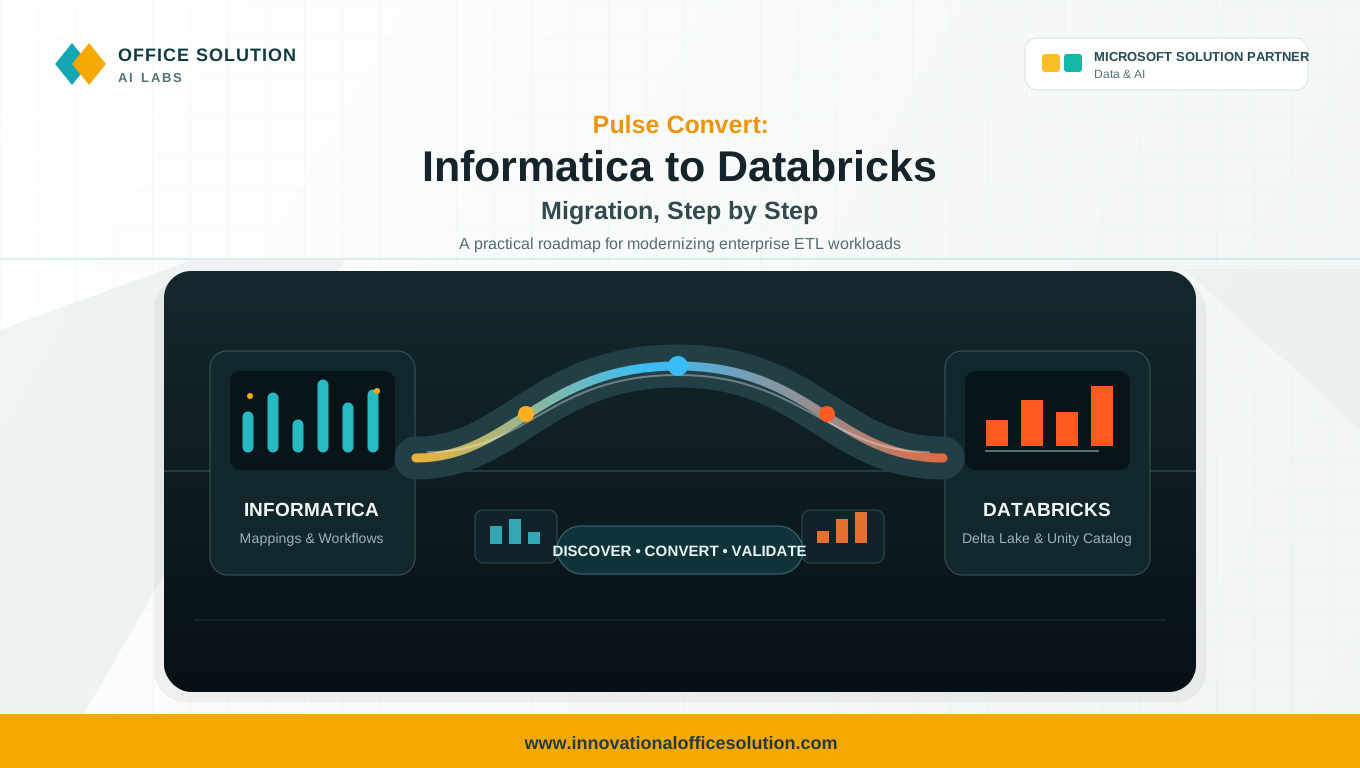
Table of Contents
Objective
This case study explains how to migrate Informatica ETL workloads to Databricks in a structured, step-by-step way. It covers common migration challenges and shows how an AI-powered accelerator like Pulse Convert can help address them.
Published by Office Solution AI Labs, Microsoft Solution Partner for Data & AI.
Why Organizations Move from Informatica to Databricks
- Lower licensing and infrastructure cost compared with PowerCenter and server-based ETL.
- One lakehouse platform for data engineering, analytics, streaming, and machine learning.
- Open formats such as Delta Lake, elastic compute, and scalable Spark processing.
Step-by-Step Migration Process
Step 1: Discover and Inventory
List every mapping, mapplet, workflow, session, parameter file, connection, and schedule in the Informatica repository. Identify unused or duplicate objects so you migrate only what matters.
Step 2: Assess Complexity
Classify each mapping as simple, medium, or complex based on transformation count, lookups, joins, expressions, stored procedure calls, reusable components, and data volume. Use this assessment to drive effort estimates and migration wave planning.
Step 3: Map Informatica Components to Databricks Targets
Choose the Databricks component that fits each element: PySpark or Spark SQL notebooks for transformations, Delta Live Tables for declarative pipelines, Databricks Workflows for orchestration, and Delta tables in Unity Catalog for storage.
Step 4: Design the Target Architecture
Plan the medallion layout (bronze, silver, and gold), workspaces, Unity Catalog structure, cluster and SQL warehouse policies, connectivity to source systems, and security roles.
Step 5: Convert Mappings and Logic
Translate Source Qualifier, Expression, Filter, Joiner, Lookup, Aggregator, Router, and Update Strategy transformations into PySpark or Spark SQL. Rebuild mapplets as reusable functions, update strategies as MERGE statements, and parameter files as job parameters.
Step 6: Migrate Data and Orchestration
Repoint sources and targets, load historical data into Delta tables, and recreate workflows, dependencies, and schedules as Databricks Workflows.
Step 7: Validate
Compare row counts, aggregates, reject records, and outputs between Informatica and Databricks. Test error handling, restartability, and performance, and obtain business sign-off.
Step 8: Deploy, Train, and Decommission
Promote the solution to production, monitor job runs and cost, and train teams. Run both environments in parallel briefly, then retire Informatica jobs and licenses.
Key Challenges in Migration
| Challenge | Why It Hurts |
|---|---|
| Mapping sprawl | Thousands of mappings and workflows can have unclear owners and limited documentation. |
| Paradigm shift | Visual, row-oriented ETL logic must be redesigned as set-based, distributed Spark code. |
| Embedded business logic | Complex expressions, lookups, and reusable mapplets can be difficult to understand and rewrite. |
| Update and CDC logic | Update Strategy and incremental patterns need careful redesign with MERGE and Delta. |
| Skill gap | ETL developers must adopt PySpark, SQL, and notebooks. |
| Validation effort | Manual output comparison across many assets is slow and error-prone. |
| Time and cost overruns | Manual rebuilds can take months and strain data teams. |
How Pulse Convert Helps
Pulse Convert is an AI-powered migration and modernization accelerator that can automate time-consuming parts of the journey.
- Automated discovery and assessment: Scan mappings, workflows, dependencies, complexity, and readiness to support fact-based planning.
- AI-assisted conversion: Accelerate the transformation of Informatica mappings, expressions, and business rules into Databricks notebooks and workflows.
- Migration validation: Source-to-target comparison and functional validation help reduce rework.
- Reduced manual effort: Automate repeatable activities instead of rewriting everything by hand.
- Enterprise-focused delivery: Use POCs, phased migration, and modernization programs with expert review.
Results You Can Expect
- 70% to 90% migration accuracy, depending on mapping complexity.
- Up to 70% reduction in migration effort.
- Faster time to value with enterprise-grade security and governance.
Start Your Migration with Pulse Convert
From legacy to next-gen. With AI. With expertise. With Pulse Convert.
Supported paths include Informatica, Oracle, Alteryx, SAP BW, SSIS, SAS, and Teradata to Databricks, plus ETL and data platform migrations to Microsoft Fabric and BI migrations to Power BI.
- Website: innovationalofficesolution.com
- Email: Admin@innovationalofficesolution.com
- Free POC offer: Apply for a free POC
FAQ: Pulse Convert
Plan Your Informatica to Databricks Migration
Review your Informatica repository with migration specialists and see how Pulse Convert can accelerate discovery, conversion, and validation.


