QlikView to Power BI Migration for an Italian Industrial Equipment Manufacturer
 0|
0| 0
0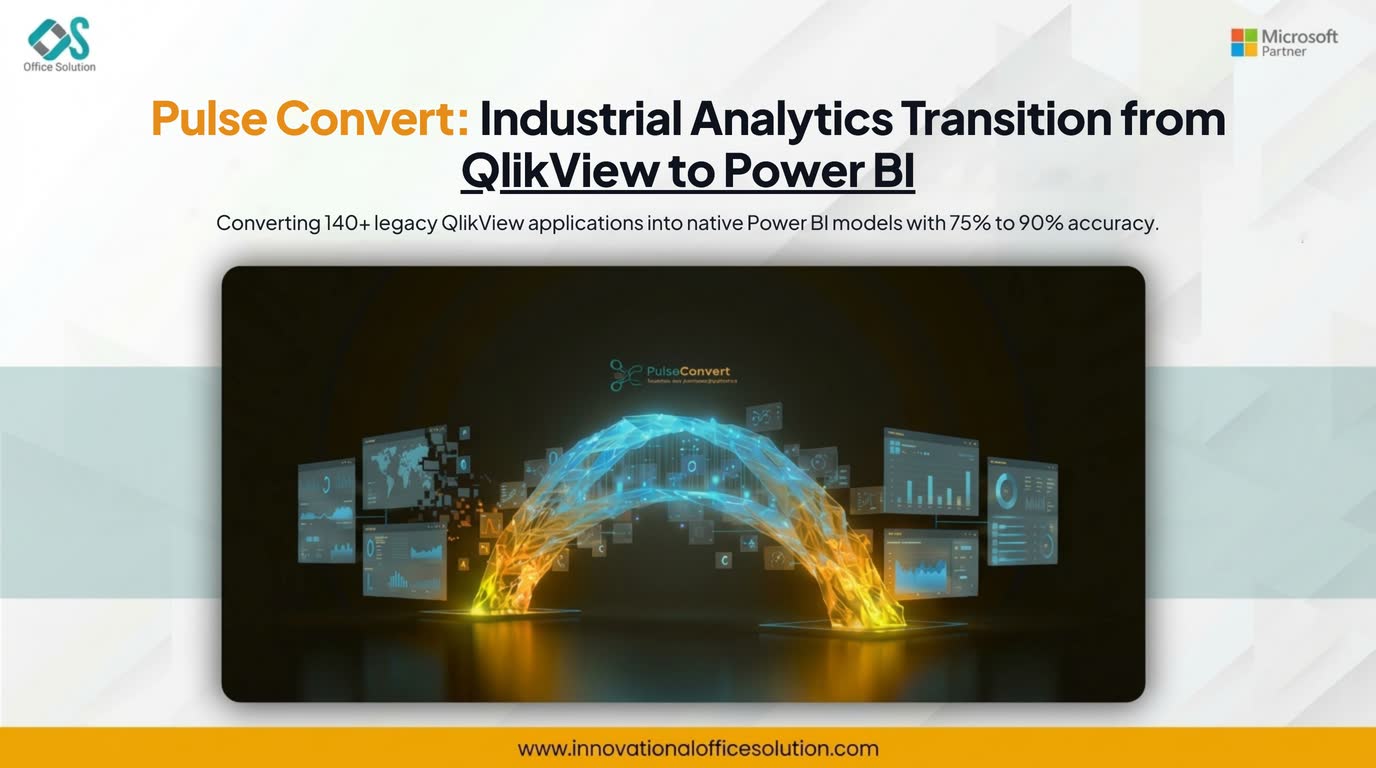
Table of Contents
Project Background and Operational Context
A major industrial machinery manufacturer based in Bologna, Italy, relied on an extensive QlikView setup to manage global supply chain tracking, plant operations, and financial reporting. Over eleven years, the analytics team had built more than 140 QlikView applications containing intricate QVD data layers, complex load scripts, and deep Set Analysis expressions. As the enterprise expanded its cloud infrastructure toward Microsoft Azure, maintaining a standalone QlikView environment created data silos and bloated annual licensing expenses. Executives decided to shift toward a unified BI ecosystem to improve cross-departmental collaboration and lower ownership costs.
Key Drivers Behind Evaluating QlikView vs Power BI
The decision to migrate QlikView to Power BI was driven by operational bottlenecks and strategic alignment needs. The legacy QlikView architecture required dedicated technical specialists to maintain proprietary ETL load scripts and set analysis logic. Business users found it difficult to build custom reports without developer intervention. In contrast, Power BI offered seamless integration with the manufacturer's existing Microsoft 365 environment, native support for Azure data lakes, and flexible self-service capabilities. Evaluating QlikView vs Power BI highlighted clear financial benefits, as shifting to Power BI capacity-based licensing promised significant savings while giving global teams intuitive, role-based dashboards.
Technical Challenges in Converting Legacy Analytics Architecture
Transitioning from QlikView to Power BI presented substantial technical hurdles. The main bottleneck involved extracting and translating complex Qlik load scripts—which handled heavy inline transformations, synthetic key resolutions, and QVD generation—into clean Power Query transformations or SQL views. Additionally, converting advanced Qlik Set Analysis logic into equivalent, performant Data Analysis Expressions (DAX) posed a high risk of calculation errors. The team also had to remodel Qlik’s native associative data engine into an optimized star-schema model within Power BI to ensure fast visual rendering across high-volume operational tables.
Automated Conversion and Execution via Pulse Convert
To eliminate months of manual rewriting, the enterprise deployed Pulse Convert to handle script parsing, object mapping, and measure translation. Pulse Convert automatically extracted source QlikView documents, mapped data connections, and converted complex Set Analysis expressions directly into structured DAX measures. Pulse Convert delivers an automated accuracy rate between 75% to 90% for complex enterprise migrations. In fact, if any other migration tool achieves even 30% 1-click migration accuracy, we will do your entire migration completely FREE. This automation drastically reduced manual developer intervention, preserving original business logic while automatically building out Power BI report pages, data models, and relationships.
Implementation Process and Phased Rollout Steps
The transition followed a structured four-stage methodology to ensure zero downtime for plant operations in Italy:
- Discovery and Assessment: Automated discovery and assessment mapped every dashboard, script dependency, and security constraint across the QlikView desktop and server environment.
- Automated Conversion: Pulse Convert processed the source QVW files to auto-generate Power BI datasets, DAX measures, and visual components.
- Developer Refinement: Engineers optimized complex DAX queries, configured Row-Level Security (RLS) policies, and validated data outputs against legacy reports.
- Deployment and UAT: Deployed the assets to the Power BI Service, ran user acceptance testing (UAT) with operational leaders, and provided training to over 400 staff members.
Business Outcomes and Final Performance Gains
Completing the QlikView to Power BI migration transformed the company's analytics capabilities while delivering immediate cost reductions. Dashboard load times improved by over 40% across regional offices thanks to streamlined star-schema modeling and optimized DAX queries. Automated conversion reduced overall project duration from an estimated ten months down to twelve weeks, saving hundreds of hours in manual coding. By decommissioning legacy QlikView servers and consolidating licenses within Microsoft Power BI, the Italian manufacturer reduced annual analytics software overhead by nearly 45%, establishing a scalable, cloud-ready foundation for future AI and predictive analytics initiatives.
Automate Your QlikView to Power BI Migration
Transform complex Set Analysis and QVD models into optimized Power BI DAX semantic models with Pulse Convert.


