Case Study: Migrating Alteryx to Databricks Lakehouse Accelerator
 0|
 0
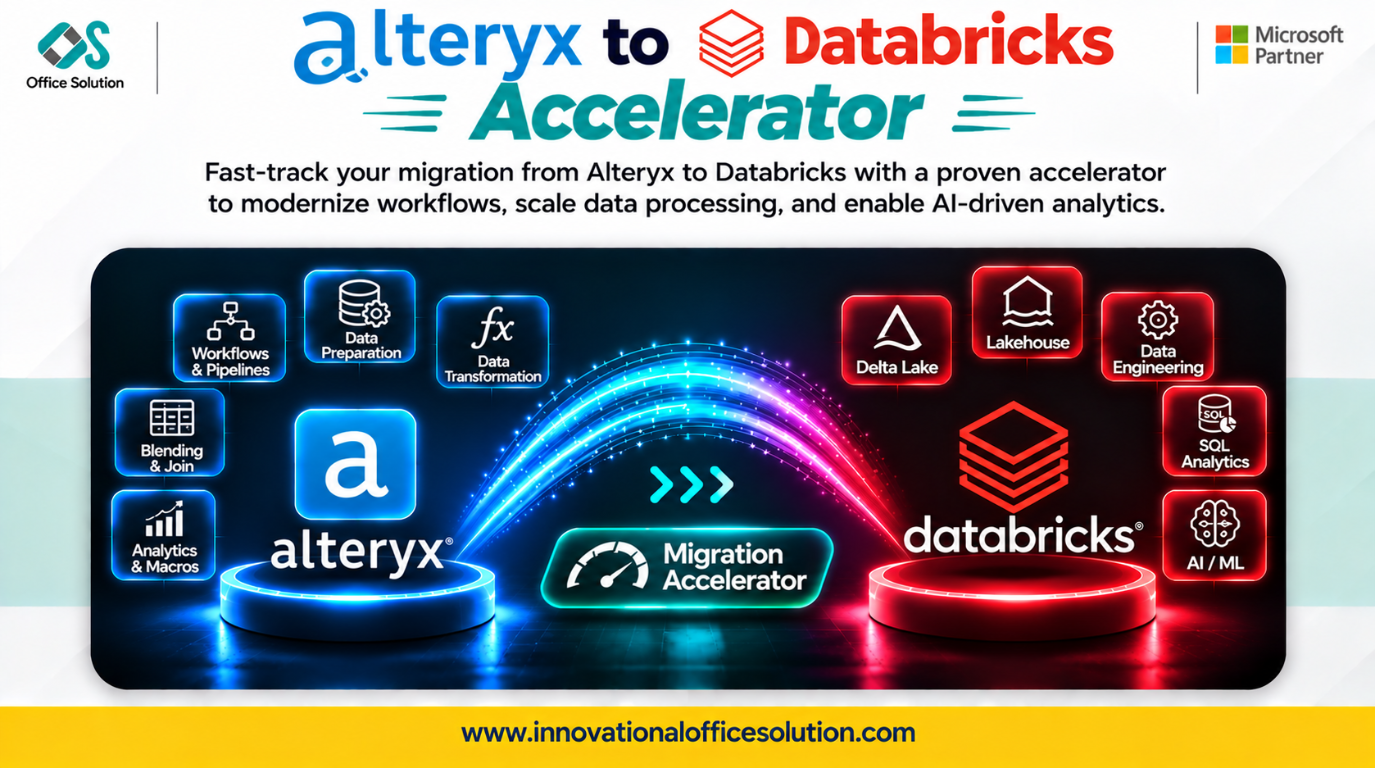
Table of Contents
Executive Summary
Organizations running self-service data prep and spatial/statistical models on Alteryx frequently face governance gaps, high per-seat licensing costs, and memory bottlenecks when scaling to terabyte- or petabyte-level datasets. Migrating to the Databricks Lakehouse unifies distributed computing, machine learning, and data governance under a single cloud architecture. This case study details the step-by-step migration process, highlights key architectural hurdles, and showcases how Pulse Convert by Office Solution AI Labs accelerates transformation to Databricks.
Key Migration Challenges: Alteryx to Databricks
Re-platforming visual, canvas-based workflows to distributed Spark code introduces several critical hurdles:
- Proprietary visual workflow parsing: Alteryx workflows (.yxmd, .yxmc, .yxwz) store proprietary XML configurations containing macros, multi-field formulas, dynamic joins, and spatial modules that lack direct one-to-one graphical equivalents in Apache Spark.
- Local memory versus distributed processing paradigms: Alteryx workflows typically process records sequentially on a single node or localized desktop engine. Re-architecting into PySpark requires redesigning data flows to avoid skewed shuffles, inefficient cross joins, and single-node bottlenecks.
- Decentralized asset governance: Business teams often maintain workflows across local desktops or disparate Alteryx Server worker nodes without centralized lineage, source control, or audit logs.
- Data validation and logic parity: Complex multi-row calculations, regex formulas, and spatial geocoding must match expected operational and financial metrics during cutover.
Step-by-Step Migration Blueprint
- Phase 1: Workflow Catalog and Assessment
- Phase 2: Lakehouse Target and Medallion Design
- Phase 3: Automated Logic Translation with Pulse Convert
- Phase 4: Databricks Pipeline Engineering and Orchestration
- Phase 5: Automated Parity Testing and Cutover
Step 1: Inventory and Complexity Assessment
- Parse Alteryx repository catalogs, Server deployments, and local .yxmd files.
- Inventory proprietary macros, external dependencies (ODBC/OLEDB, shared folders, flat files), and scheduling jobs.
- Classify workflows by complexity and decommission unused or redundant workflows before migration.
Step 2: Target Medallion Architecture Setup
- Map ingest, intermediate preparation, and reporting layers into the Delta Lake Medallion Architecture.
- Configure Databricks Unity Catalog to enforce access policies, centralized lineage, and auditing.
Step 3: Automated Workflow and Logic Conversion
- Convert Alteryx workflow XML structures into native, vectorized PySpark notebooks or Databricks SQL scripts.
- Transform multi-field formulas, record generators, and joins into distributed Spark DataFrame transformations.
- Use purpose-built automation tooling to avoid slow, error-prone manual code rewrites.
Step 4: Pipeline Engineering and Orchestration
- Structure converted PySpark modules into Databricks Workflows or Delta Live Tables (DLT) for automated quality checks and dependency handling.
- Replace hardcoded local paths and credential strings with Databricks Secrets and dynamic parameter widgets.
Step 5: Parity Validation, UAT, and Decommission
- Run automated dual-run reconciliation comparing row counts, column checksums, and aggregate distributions across historical baseline datasets.
- Transition reporting layers (Tableau, Power BI, Excel) to Databricks SQL endpoints.
- Decommission on-premises Alteryx Server infrastructure and reallocate desktop licenses.
Accelerate Alteryx Modernization with Pulse Convert
Manually translating hundreds of complex Alteryx workflows into PySpark is tedious and costly. Pulse Convert by Office Solution AI Labs automates discovery, mapping extraction, and PySpark generation.
- 70%-90% automated conversion accuracy: Delivers automated translation of Alteryx workflows, macros, and formulas into clean, optimized PySpark and Databricks SQL.
- Up to 70% effort reduction: Bypasses manual recoding, reduces migration timelines, and frees data engineers to focus on business optimization.
- Automated discovery and assessment: Inspects legacy Alteryx XML files upfront to identify dependencies, complexity ratings, and migration readiness.
- Enterprise-ready validation: Provides automated source-to-target schema validation and logic parity verification for confident deployment.
FAQ: Pulse Convert for Alteryx to Databricks
Start Your Databricks Lakehouse Migration
Modernize your legacy data prep workflows with enterprise-grade automation and proven accelerators.
- Explore solutions: Innovational Office Solution
- Claim your free Proof of Concept (POC): Request a free migration POC
- Contact us: Connect with our solution engineering team at Admin@innovationalofficesolution.com


