Case Study: Migrating Informatica PowerCenter to Databricks Lakehouse Accelerator
 0|
 0
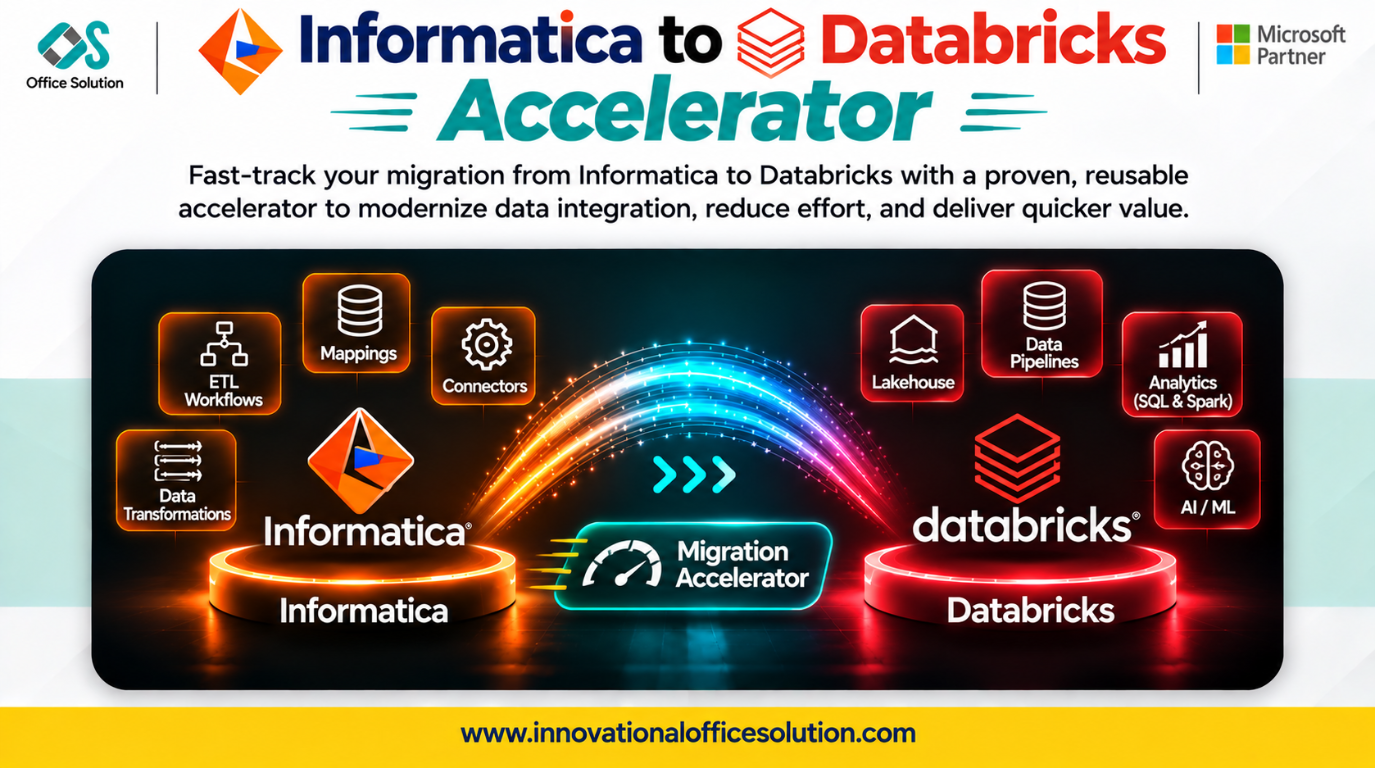
Table of Contents
Executive Summary
Enterprises running legacy on-premises ETL engines like Informatica PowerCenter face mounting infrastructure overhead, rigid scaling boundaries, and high licensing costs. Modernizing data engineering workloads to the Databricks Lakehouse enables unified batch and streaming, elastic compute, and direct support for machine learning. This case study details a step-by-step methodology for executing an Informatica-to-Databricks migration, outlines common implementation pitfalls, and shows how Pulse Convert by Office Solution AI Labs accelerates the journey.
Key Migration Challenges: Informatica to Databricks
Modernizing legacy visual mappings and workflow graphs to modern cloud code introduces distinct technical roadblocks:
- Proprietary transformation logic: Informatica relies on internal expressions, mapplets, lookup caches, update strategies, and unconnected transformations that do not have one-to-one graphical equivalents in Apache Spark.
- Orchestration and workflow decoupling: Workflow Manager constructs (worklets, event waits, decision tasks, and session dependencies) must be re-architected into modular Databricks Workflows or Delta Live Tables (DLT).
- Complex script and parameter-file dependencies: Legacy deployments often wrap mappings in operating system shell scripts (pmcmd, parameter files, pre/post-session commands) requiring manual discovery and refactoring.
- Data consistency and reconciliation: Validating output parity across thousands of historical pipeline runs without disrupting daily business SLAs.
Step-by-Step Migration Blueprint
- Phase 1: Catalog and Assessment
- Phase 2: Target Data Model and Architecture Design
- Phase 3: Automated Logic Conversion with Pulse Convert
- Phase 4: Databricks Pipeline Engineering and Orchestration
- Phase 5: Parity Testing, Cutover, and Decommission
Step 1: Catalog, Assessment, and Rationalization
- Extract Informatica repository metadata via PowerCenter XML exports.
- Inventory mappings, sessions, workflows, parameter files, and source/target connectors.
- Classify workloads by complexity (simple passthrough versus nested lookups/mapplets) and retire redundant or obsolete flows.
Step 2: Target Architecture and Medallion Design
- Define target schemas across the Bronze, Silver, and Gold layers of the Medallion Architecture.
- Configure Databricks Unity Catalog for centralized access control and lineage tracking.
Step 3: Automated Logic and Code Conversion
- Translate Informatica mapping XML structures into native, vectorized PySpark notebooks or SQL scripts.
- Convert Informatica expression macros, lookups, and router logic into distributed Spark DataFrame transformations.
- Leverage automated migration accelerators to bypass manual code authoring.
Step 4: Pipeline Engineering and Orchestration
- Organize converted PySpark logic into Databricks Workflows or Delta Live Tables (DLT) for declarative pipeline execution.
- Parameterize environments using Databricks widgets, secrets, and task values to replace legacy .par parameter files.
Step 5: Data Parity, Parallel Run, and Cutover
- Execute automated source-to-target row-count, hash-check, and aggregate-value reconciliations.
- Run legacy Informatica sessions and Databricks jobs in parallel across financial closes to verify parity.
- Switch downstream reporting systems to Databricks SQL warehouses and decommission Informatica server nodes.
How Pulse Convert Accelerates Your Migration
Manual reimplementation of Informatica mappings into PySpark is time-consuming and error-prone. Pulse Convert provides an AI-powered migration accelerator specifically built to modernize legacy ETL workloads to Databricks.
- Automated code conversion accuracy: Delivers 70%-90% automated migration accuracy, translating Informatica transformations, mapplets, and workflows into clean PySpark and Databricks SQL.
- Up to 70% effort reduction: Reduces manual engineering overhead, code rewrites, and developer fatigue.
- Automated discovery and assessment: Rapidly inspects legacy Informatica XML exports to analyze assets, dependencies, and transformation complexity before writing code.
- Built-in migration validation: Compares source and target data schemas and logic to verify functional accuracy early in the delivery lifecycle.
FAQ: Pulse Convert for Informatica to Databricks
Begin Your Databricks Lakehouse Transformation
Accelerate your legacy ETL modernization with enterprise-grade automation and AI-driven precision.
- Explore our solutions: Innovational Office Solution
- Claim your free Proof of Concept (POC): Request a free migration POC
- Contact us: Connect with our architecture team at Admin@innovationalofficesolution.com


