Oracle to Microsoft Fabric Migration Accelerator: A Step-by-Step Case Study
 0|
 0
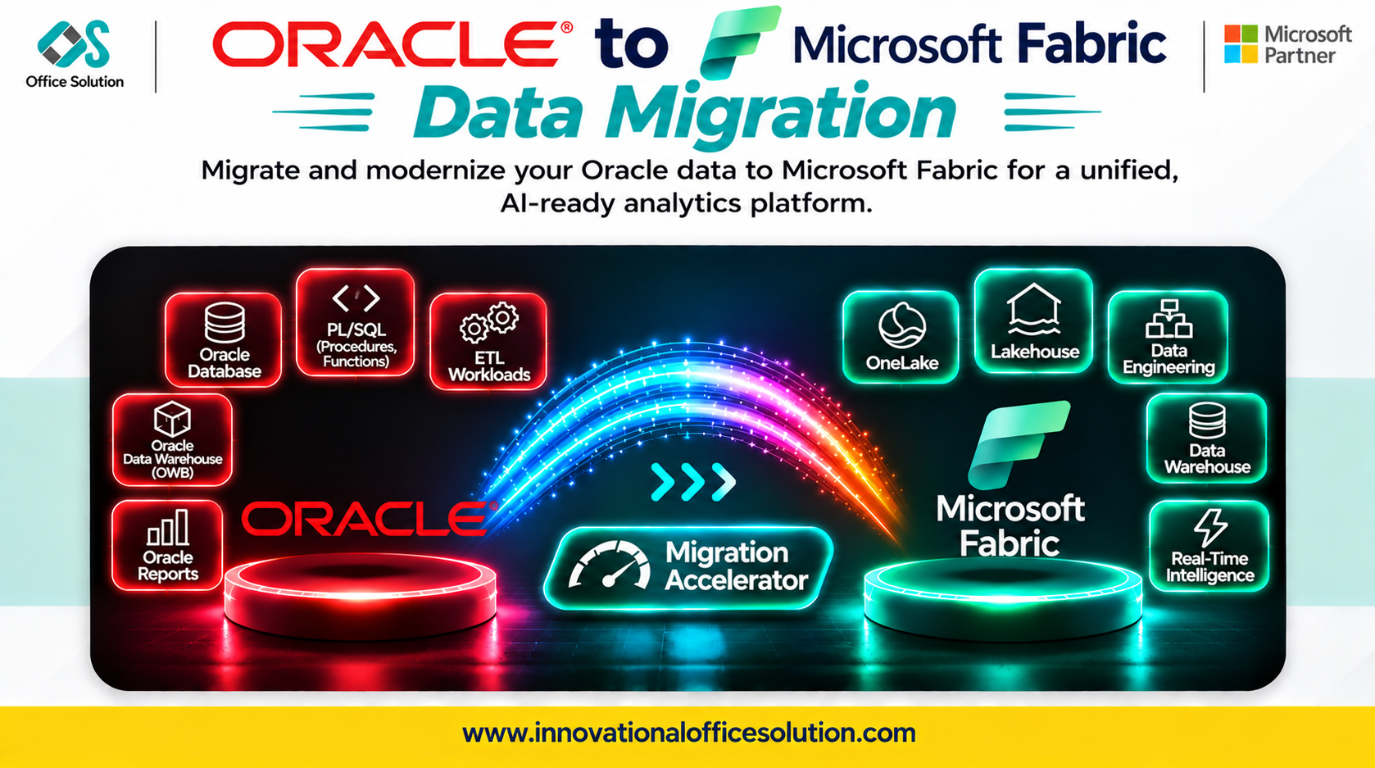
Table of Contents
Oracle to Microsoft Fabric Migration Accelerator: A Step-by-Step Case Study
Client profile: Enterprise data teams running Oracle databases and ETL workloads seeking modernization on Microsoft Fabric.
Solution: Pulse Convert Oracle to Fabric Accelerator by Office Solution AI Labs.
Automated accuracy claim: 70–90% of schema and ETL code can be converted automatically, with the remainder requiring expert fine-tuning and validation.
Executive Summary
Moving from Oracle to Microsoft Fabric is not a simple database swap. Oracle PL/SQL logic, sequences, synonyms, and proprietary functions have no direct Fabric equivalents. Teams that treat this as a table copy and report rebuild often discover broken pipelines, mismatched data types, and dashboards that quietly return wrong numbers.
This case study describes a practical migration process, the challenges that derail projects, and how Pulse Convert accelerates repeatable work so engineers can focus on complex, high-judgment edge cases.
Step-by-Step Migration Process
Step 1: Discovery and Inventory (Weeks 1–2)
Extract metadata from Oracle data dictionary views to inventory tables, views, materialized views, PL/SQL packages, procedures, triggers, sequences, and ETL jobs.
- Key output: A migration backlog prioritized by business value rather than object count.
- Flag unused legacy objects for retirement instead of migration.
- Critical check: Document Oracle-specific constructs including ROWNUM, CONNECT BY, NVL, DECODE, sequences, and autonomous transactions.
Step 2: Target Architecture Design (Week 2)
| Oracle workload | Fabric target |
|---|---|
| OLTP tables and staging | Fabric Warehouse or Lakehouse |
| PL/SQL batch ETL | Fabric Data Factory pipelines and notebooks |
| Materialized views | Fabric Warehouse views or scheduled notebooks |
| Reporting queries | Power BI Direct Lake or SQL endpoint |
| Oracle ETL jobs | Data Factory pipelines or migrated notebooks |
Fabric is a SaaS platform: capacity units (CUs) determine cost and performance. Design workspace and capacity allocation early to avoid throttling after cutover.
Step 3: Schema and Code Conversion (Weeks 3–8)
Convert DDL first, then PL/SQL, and finally ETL orchestration.
- PL/SQL packages: Cursors, exception blocks, and autonomous transactions need redesign into T-SQL or PySpark, not mechanical translation.
- Sequences and identity: Oracle sequences become Fabric IDENTITY columns or generated keys; key order and gaps must be validated.
- Data type drift: Oracle NUMBER and DATE semantics differ from Fabric types. NUMBER(38) precision and DATE time components can cause silent errors.
- NULL and empty strings: Oracle treats an empty string as NULL, while Fabric does not. Explicit NULL handling affects joins and filters.
- Hierarchical queries: Rewrite CONNECT BY logic as recursive CTEs.
- Validation: Tools can translate repeatable DDL and straightforward SQL, but every converted object must be checked against the source.
Step 4: Validation and Reconciliation (Weeks 9–10)
Run parallel queries to compare row counts, aggregates, and business KPIs between Oracle and Fabric. Automated reconciliation is essential because manual spot-checks can miss NULL, empty-string, and date-time edge cases.
Step 5: Cutover and Decommission (Weeks 11–12)
Use phased cutover by subject area and keep Oracle read-only during the transition window. Track Oracle license retirement as a formal cost-saving milestone.
Key Challenges in Oracle-to-Fabric Migration
| Challenge | Why it matters | Mitigation |
|---|---|---|
| PL/SQL complexity | Packages and triggers have no direct equivalent. | Redesign with T-SQL or PySpark and require engineer review. |
| NULL versus empty string | Oracle empty-string behavior differs from Fabric. | Apply explicit NULL handling in converted logic. |
| Date and NUMBER precision | Silent rounding or time-loss errors can change results. | Validate precision and time components per column. |
| Sequences and identity | Key gaps or collisions can appear after migration. | Validate generated key behavior after loading. |
| CONNECT BY hierarchies | No native direct equivalent exists. | Rewrite with recursive CTEs. |
| Fabric capacity planning | CU throttling affects performance and cost. | Size capacity and workspaces before cutover. |
How Pulse Convert Accelerates the Journey
Pulse Convert Oracle to Fabric Accelerator targets high-effort, low-judgment work: bulk DDL translation, standard SQL and PL/SQL conversion, and automated inventory analysis.
What It Does Well
- Automates 70–90% of schema and repeatable code conversion.
- Reduces manual translation effort on bulk objects.
- Generates a conversion inventory with complexity flags for review prioritization.
What Still Needs Humans
- Complex PL/SQL packages and autonomous transactions.
- Hierarchical query rewrites.
- Business logic validation.
- Source-to-target reconciliation and acceptance.
No tool migrates every Oracle object perfectly. Pulse Convert automates the repeatable bulk and routes difficult cases to engineers; accuracy is validated against the Oracle source.
Next Step: Free POC
See Pulse Convert on your Oracle workload. We can migrate a representative sample to Microsoft Fabric, validate it against your source, and demonstrate accuracy before you commit.
- Contact: Admin@innovationalofficesolution.com
- Free POC offer: Request a migration proof of concept
- Website: Innovational Office Solution
- Office Solution AI Labs — Microsoft Solution Partner


