Snowflake to Databricks Migration Accelerator: A Step-by-Step Case Study
 0|
 0
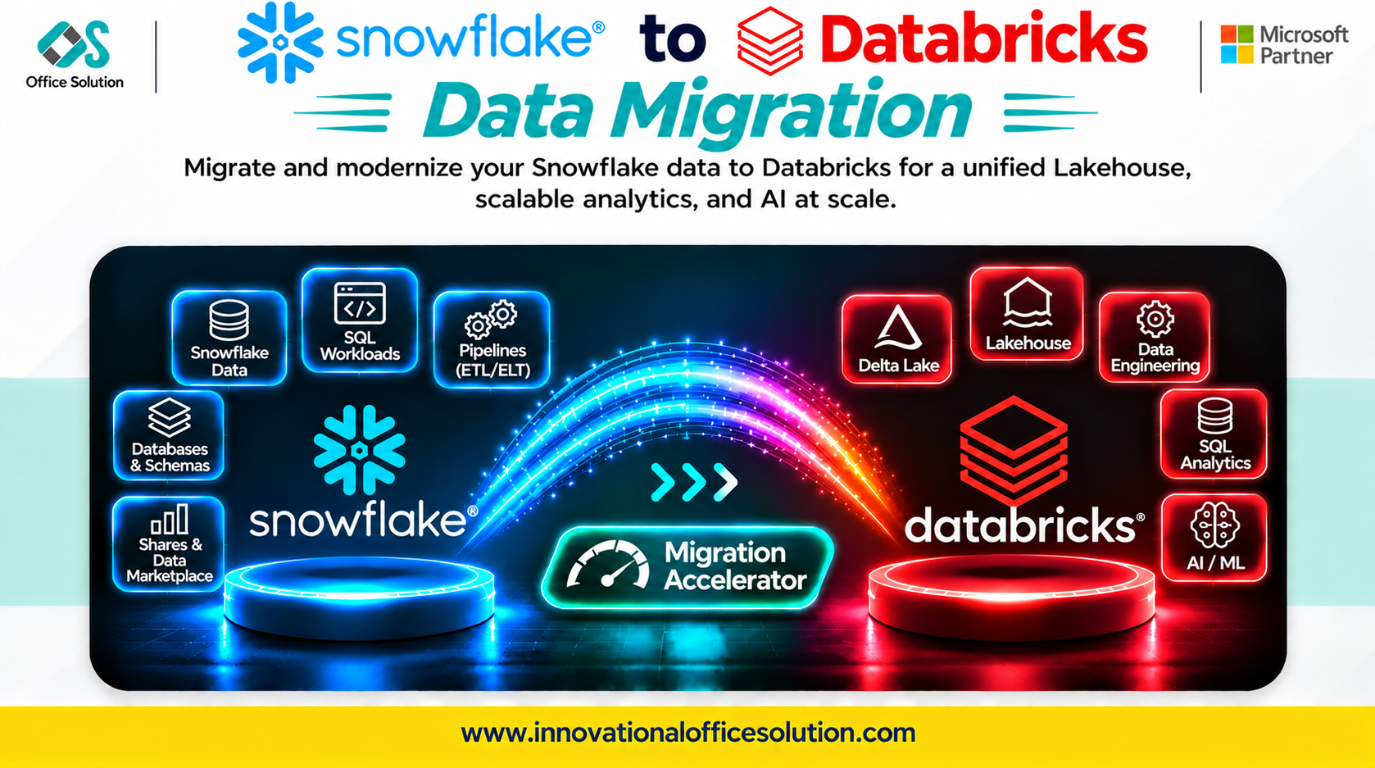
Table of Contents
Snowflake to Databricks Migration Accelerator: A Step-by-Step Case Study
Client profile: Enterprise data teams running Snowflake warehouses and seeking modernization on Databricks Lakehouse.
Solution: Pulse Convert Snowflake to Databricks Accelerator by Office Solution AI Labs.
Automated accuracy claim: 70–90% of schema and ETL or SQL code can be converted automatically, with the remainder requiring expert fine-tuning and validation.
Executive Summary
Moving from Snowflake to Databricks is not a simple cloud-to-cloud copy. Snowflake clustering keys, micro-partitioning, streams and tasks, Snowflake Scripting procedures, VARIANT semi-structured data, and time travel have no one-to-one Databricks equivalents.
Teams that treat migration as copying tables and rebuilding reports can encounter broken incremental pipelines, silent performance loss, and different query results. This case study describes a practical process, the challenges that derail projects, and how Pulse Convert accelerates repeatable work.
Step-by-Step Migration Process
Step 1: Discovery and Inventory (Weeks 1–2)
Extract metadata from INFORMATION_SCHEMA to inventory tables, clustering keys, views, streams, tasks, stored procedures, UDFs, external tables, and ETL jobs.
- Key output: A migration backlog prioritized by business value rather than table count.
- Flag stale tables and unused tasks for retirement instead of migration.
- Critical check: Document clustering keys, micro-partition usage, VARIANT columns, streams and tasks, and time-travel dependencies.
Step 2: Target Architecture Design (Week 2)
| Snowflake workload | Databricks target |
|---|---|
| Standard tables | Delta Lake tables in Unity Catalog |
| Clustered tables | Delta partitioning plus OPTIMIZE and ZORDER |
| Streams and tasks | Delta Live Tables and Auto Loader |
| Snowflake Scripting procedures | PySpark notebooks or SQL procedures |
| VARIANT data | Delta columns with from_json and schema evolution |
| External tables | Unity Catalog external tables or volumes |
| Reporting queries | Databricks SQL Warehouse |
| Time travel | Delta history with RESTORE or CLONE |
Design the Unity Catalog hierarchy and compute policies early. Cluster sizing and autoscaling drive cost and performance after cutover.
Step 3: Schema and Code Conversion (Weeks 3–8)
Convert DDL first, then stored procedures and CDC pipelines, and finally orchestration.
- Snowflake SQL: Rewrite IFF, NVL, QUALIFY, FLATTEN, ARRAY_AGG, LATERAL, and :: casting into Spark SQL equivalents.
- Clustering and micro-partitioning: Redesign as Delta partitioning, OPTIMIZE, and ZORDER.
- Streams and tasks: Rebuild native CDC with Delta Live Tables or Auto Loader and merge logic.
- Snowflake Scripting: Rewrite control flow, cursors, and exception handling into PySpark or Spark SQL.
- VARIANT data: Define JSON schemas and parsing behavior for reliable semi-structured processing.
- Time travel: Replace it with Delta history and RESTORE or CLONE patterns.
- Case sensitivity: Standardize object and column names because Spark is case-sensitive by default.
- Validation: Check every converted object against the source rather than assuming syntactic translation preserves behavior.
Step 4: Validation and Reconciliation (Weeks 9–10)
Run parallel queries comparing row counts, aggregates, and business KPIs between Snowflake and Databricks. Automate reconciliation, including VARIANT parsing, case behavior, and timezone handling.
Step 5: Cutover and Decommission (Weeks 11–12)
Use phased cutover by subject area and keep Snowflake read-only during the transition window. Track Snowflake credits and storage retirement as a formal cost-saving milestone.
Key Challenges in Snowflake-to-Databricks Migration
| Challenge | Why it matters | Mitigation |
|---|---|---|
| Clustering and micro-partition loss | Query performance can regress. | Redesign as partitioning, OPTIMIZE, and ZORDER. |
| Streams and tasks | No native Databricks CDC equivalent exists. | Rebuild with Delta Live Tables and Auto Loader. |
| Snowflake Scripting procedures | Cursors and exception blocks need rewrite. | Redesign in PySpark or Spark SQL. |
| VARIANT data | Parsing and performance differ significantly. | Define JSON schemas and validate output. |
| Time travel and cloning | There is no direct equivalent. | Use Delta history and RESTORE or CLONE. |
| Case sensitivity | Identifier folding differs from Spark. | Standardize naming during conversion. |
| SQL dialect gaps | Functions such as IFF and QUALIFY do not translate directly. | Rewrite and test each function against source. |
| Unity Catalog governance | Permissions and lineage must be rebuilt. | Plan catalog and schema structure before load. |
How Pulse Convert Accelerates the Journey
Pulse Convert Snowflake to Databricks Accelerator targets high-effort, repeatable work: bulk DDL translation, standard SQL conversion, and automated inventory analysis.
What It Does Well
- Automates 70–90% of schema and repeatable SQL or ETL code conversion.
- Reduces manual translation effort on bulk objects.
- Generates a conversion inventory with complexity flags for review prioritization.
What Still Needs Humans
- Complex Snowflake Scripting procedures.
- Streams and tasks CDC rebuild.
- VARIANT parsing strategy.
- Business logic validation and source-to-target reconciliation.
No tool migrates every Snowflake object perfectly. Pulse Convert automates repeatable bulk work and routes difficult cases to engineers; accuracy is validated against the Snowflake source.
Next Step: Free POC
See Pulse Convert on your Snowflake workload. We can migrate a representative sample to Databricks, validate it against your source, and demonstrate accuracy before you commit.
- Contact: Admin@innovationalofficesolution.com
- Free POC offer: Request a migration proof of concept
- Website: Innovational Office Solution
- Office Solution AI Labs — Microsoft Solution Partner


