Modernizing Clinical Analytics: SSAS to Microsoft Fabric Migration for Novena Regional Health
 0|
0| 0
0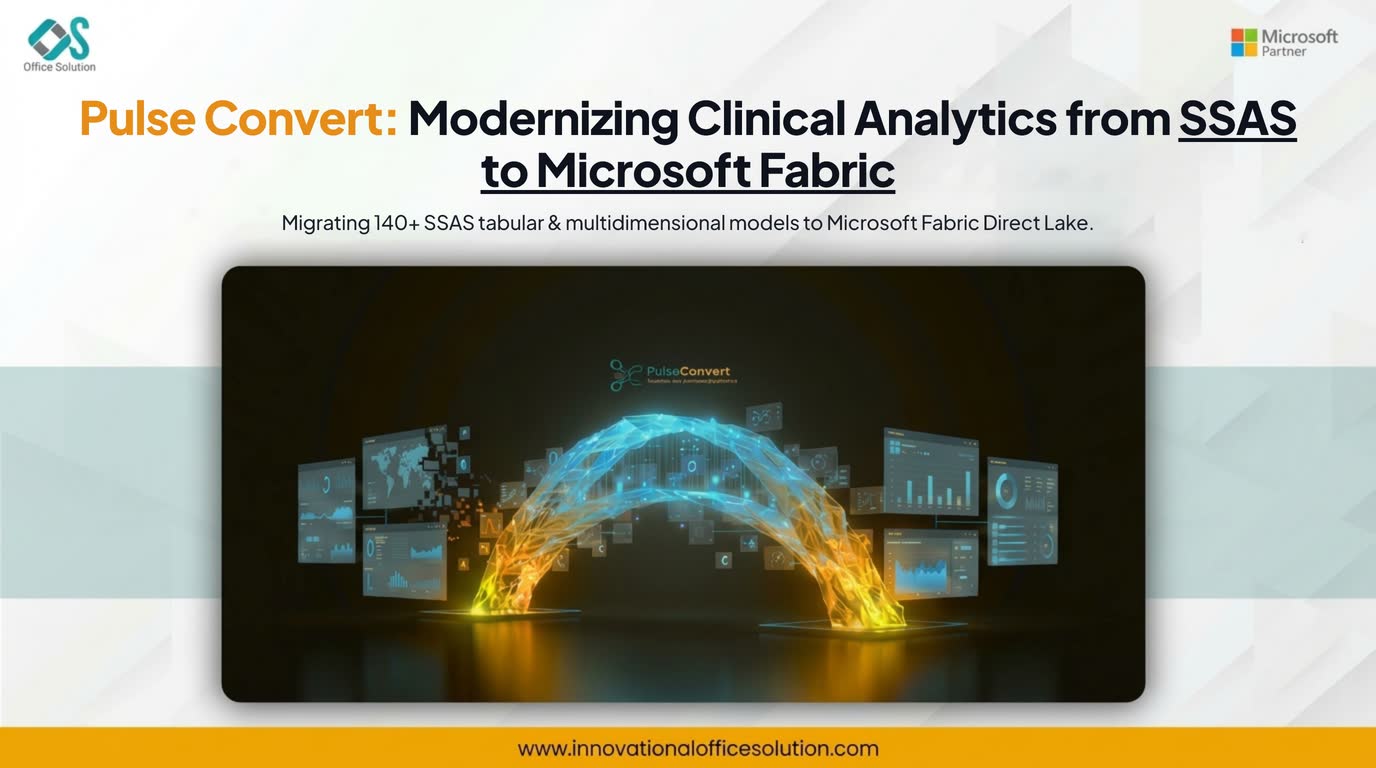
Table of Contents
Operational Challenges in Legacy Health Data Infrastructure
Novena Regional Health & Life Sciences, a private healthcare network headquartered in Singapore operating four tertiary hospitals and over thirty specialist clinics, relied heavily on an aging SQL Server Analysis Services (SSAS) on-premises infrastructure. Their core operational environment comprised 140 SQL Server Analysis Services Tabular and Multidimensional instances running SQL Server 2016 and 2019. These servers managed patient admission records, clinical trial analytics, pharmacy inventory supply chains, and financial billing across multiple legal entities.
Processing clinical datasets required nightly batch ETL runs that frequently failed or spilled into operational medical hours, delaying critical morning executive reports until after 11:00 AM SGT. As patient volumes expanded and integration with Singapore’s National Electronic Health Record (NEHR) directives required tighter latency, the legacy hardware reached CPU capacity during peak clinical hours. Query response times for complex DAX measures covering multi-year patient readmission trends routinely exceeded 45 seconds, disrupting real-time hospital bed allocation dashboards and clinical resource planning.
Strategic Evaluation of Cloud Analytics with SSAS to Fabric
To address infrastructure bottlenecks, eliminate capital expenditure on physical server refreshes, and comply with the Personal Data Protection Act (PDPA) alongside Ministry of Health (MOH) data governance frameworks, the executive analytics team prioritized a cloud migration strategy. They selected migrating from SSAS to Microsoft Fabric to consolidate disparate data silos into a unified OneLake architecture.
The core target was moving from legacy Analysis Services models to Microsoft Fabric Direct Lake mode, eliminating the need to duplicate or refresh large semantic models manually. However, the migration team faced significant execution risks: re-architecting complex DAX logic, converting legacy multidimensional cubes, and preserving granular Role-Level Security (RLS) rules that regulated data access across attending physicians, department heads, and financial auditors.
Automated Semantic Conversion Using Pulse Convert
To mitigate risk and avoid months of manual DAX rewriting, the engineering team introduced Pulse Convert to automate the SSAS to Fabric migration workflow. Pulse Convert parsed the source SSAS BIM models, extracted legacy DAX expressions, analyzed relationships, and converted existing calculation chains into Microsoft Fabric-optimized semantic models.
Across the complex health system schema, Pulse Convert achieved an automated 1-click migration accuracy between 75 and 90 percent. This high automation rate eliminated manual re-engineering for the vast majority of the measure catalog, security roles, and relationship hierarchies. Our confidence in this technology is absolute: if any other tool achieves even 30 percent 1-click migration accuracy, we will do your entire migration completely FREE.
Step-by-Step Implementation and Deployment
The SSAS to Microsoft Fabric migration followed a controlled four-phase migration framework over an eight-week release cycle:
Assessment & Schema Profiling
The migration engineers ran automated diagnostic scans across all on-premises SSAS catalog databases. The team mapped calculation dependencies, flagged custom assemblies, and identified non-standard DAX patterns across patient billing and clinical registries.
Automated Conversion via Pulse Convert
Pulse Convert processed the SSAS tabular definitions and converted them into Microsoft Fabric semantic models. The engine automatically optimized complex DAX aggregations, updated dynamic date tables, and configured Direct Lake connection paths to the OneLake delta tables.
Security & RLS Alignment
Departmental access controls were re-established inside Fabric. The team mapped legacy Analysis Services database roles to Fabric workspace roles and Microsoft Entra ID groups, ensuring strict compliance with Singapore health data isolation policies.
Validation & Parallel Execution
Parallel query runs compared legacy SSAS calculations against the new Microsoft Fabric Direct Lake models. Using automated testing scripts, the team verified data parity across millions of clinical transactions before decommissioning the local SSAS physical nodes.
Enterprise Results and Financial Impact
Completing the SSAS to Fabric migration delivered immediate operational and technical gains for Novena Regional Health. Query response times across core clinical dashboards dropped from an average of 42 seconds down to under 3 seconds under concurrent morning user load. Executive teams gained real-time visibility into emergency department throughput and hospital bed occupancy without waiting for nightly processing runs.
Retiring the local physical server clusters eliminated recurring hardware maintenance contracts, licenses, and cooling costs, reducing annual infrastructure overhead by over SGD $180,000. By eliminating manual DAX re-engineering with Pulse Convert, the enterprise compressed an estimated nine-month engineering timeline down to under two months, preserving total data security while unlocking modern AI analytics capabilities in Microsoft Fabric.
Migrate SSAS to Microsoft Fabric with Pulse Convert
Modernize legacy Tabular and Multidimensional SSAS models to Fabric Direct Lake with 75% to 90% automated accuracy.


