Tableau to Power BI Migration for a Swiss Enterprise Software Vendor
 0|
0| 0
0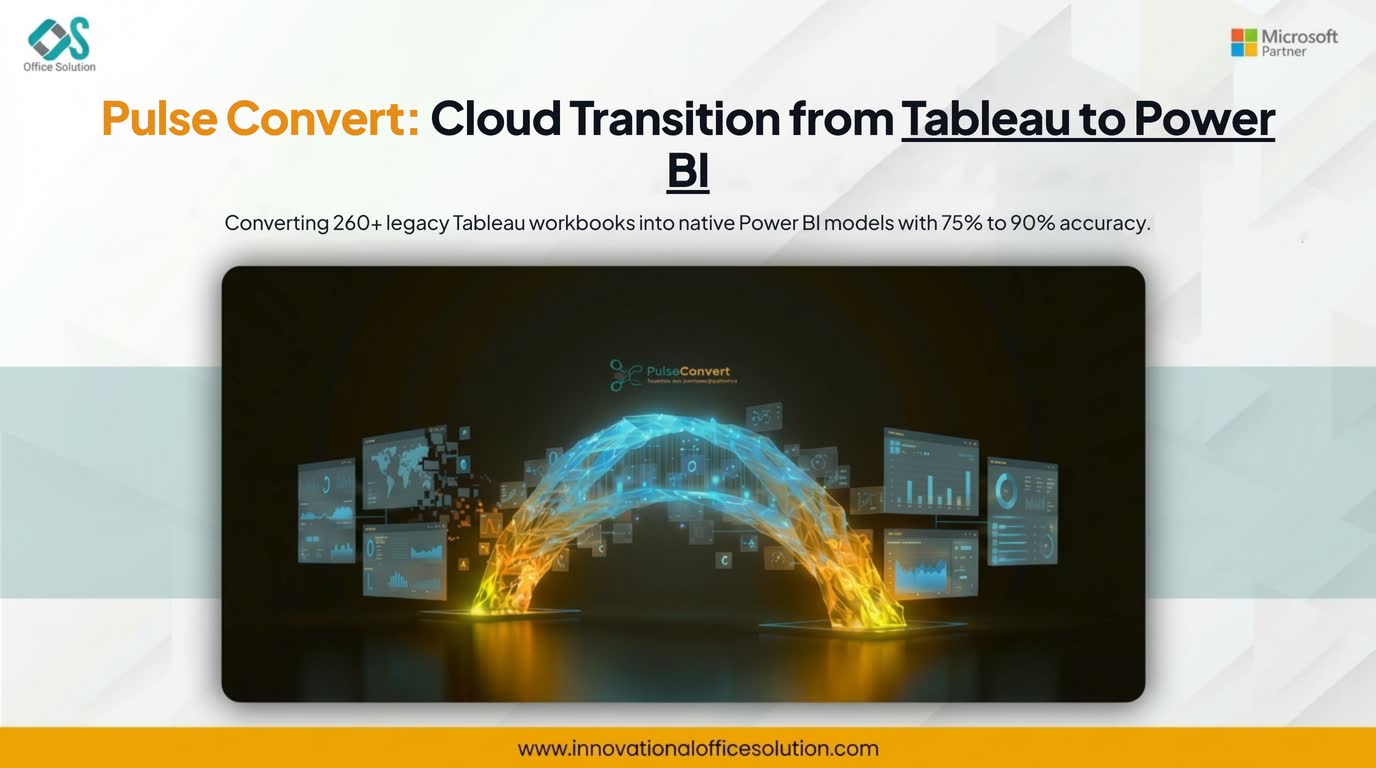
Table of Contents
Technical Landscape and Operational Context
A cloud-native enterprise software provider based in Zurich, Switzerland, delivers managed IT services and SaaS platforms to corporate clients across Western Europe. Over seven years, their internal operational teams and external client reporting managers built over 260 Tableau workbooks to monitor software performance, platform uptime, customer license utilization, and cloud consumption costs. These reporting assets relied heavily on Tableau Server, featuring embedded calculations, custom parameter actions, and multi-layered Level of Detail (LOD) expressions connected to live databases.
Cost Overhead and Governance Disconnects
Managing an independent Tableau Server deployment became increasingly inefficient as the firm expanded its enterprise customer base. High per-user licensing costs and standalone infrastructure management created unnecessary friction for the IT operations group. Furthermore, executive leadership decided to standardize the organization's internal analytics infrastructure on Microsoft Fabric and Power BI to improve data governance and integrate seamlessly with Microsoft Azure Active Directory. The central goal was to convert Tableau to Power BI across all operational divisions while eliminating redundant vendor costs.
Evaluating the Tableau to Power BI Migration Approach
Transitioning 260 production workbooks manually presented major resource challenges. The internal data architecture team estimated that manually converting complex FIXED and INCLUDE LOD expressions into DAX, rebuilding semantic models into star-schema formats, and recreating visual layouts in Power BI would require 14 months of dedicated developer effort. To execute a smooth Tableau to Power BI migration without impacting live client SLA reporting, engineering leaders sought an enterprise Data Migration framework and specialized Cloud Migration tools to automate code translation and structural mapping.
Automated Execution Using Pulse Convert
To eliminate tedious manual conversion tasks, the company deployed Pulse Convert, a specialized Tableau to Power BI migration tool. The software ingested raw Tableau workbook metadata (.twb/.twbx) and deconstructed the underlying XML logic. Pulse Convert automatically translated complex LOD expressions into production-ready DAX calculations while converting multi-table data sources into Power BI semantic models. This automated transformation allowed data engineers to migrate Tableau to Power BI without rewriting complex backend logic or reconstructing interactive dashboard layouts from scratch.
Conversion Accuracy and Free Migration Guarantee
During vendor selection, the engineering team tested several basic code converters on workbooks containing nested aggregations and custom parameters. Competing tools failed on complex formulas, yielding less than 20% usable code output. Pulse Convert delivered a 75% to 90% direct 1-click migration accuracy across the firm's entire analytics portfolio. The platform stands behind this capability with a bold guarantee: if any other tool achieves even 30% 1-click migration accuracy on your target source files, we will perform your entire Tableau to Power BI migration completely FREE.
Validation, Testing, and Phased Rollout
The enterprise executed its Tableau to Power BI conversion in structured phases over a seven-week period. Automated testing scripts ran numerical reconciliations between historical Tableau extracts and newly generated Power BI semantic models to ensure zero data drift across billing and performance metrics. Fine-grained security parameters were mapped directly to Power BI Row-Level Security (RLS) to maintain strict tenant isolation. Once verified, converted reports were published directly to target Power BI workspaces connected to Microsoft Fabric.
Business Impact and Operational Results
By establishing a structured pipeline to migrate from Tableau to Power BI, the Swiss tech company reduced annual business intelligence software expenditures by 46%. Using Pulse Convert reduced the overall project timeline from an estimated 14 months down to under 50 days, enabling senior engineers to focus on building AI-driven predictive maintenance models rather than rewriting legacy reports. Operations managers and client leaders now access real-time system performance dashboards directly within Microsoft Teams, backed by enterprise-grade governance and cloud scalability.
Modernize Tableau to Microsoft Power BI with Pulse Convert
Automate your Tableau to Power BI migration with 75% to 90% accuracy, cutting project timelines and infrastructure costs.


