The Algorithmic Engine: Scaling Enterprise Demand Generation, Intent Capture, and High-Fidelity Conversational Mechanics via Autonomous Voice Architectures
 0|
0| 0
0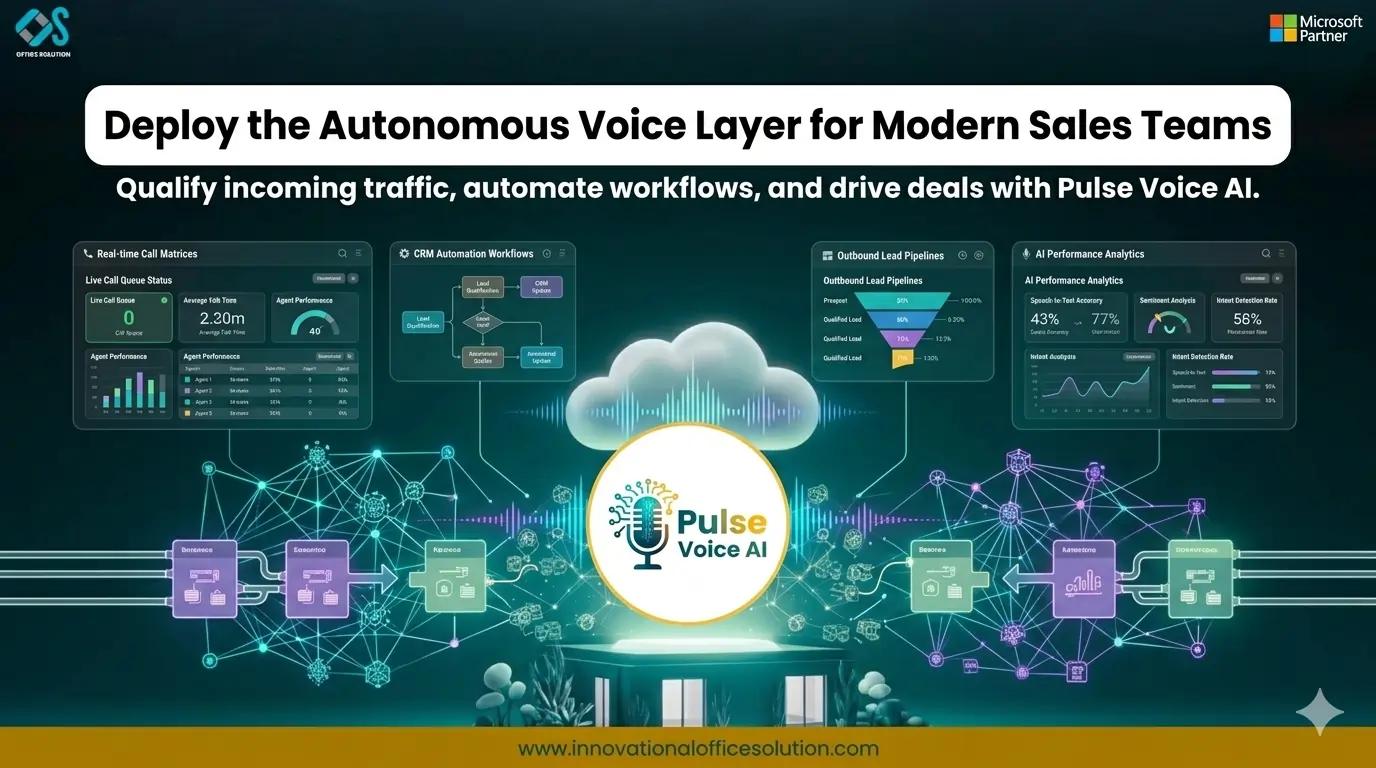
Table of Contents
Modern commercial growth requires structural velocity, infinite operational scalability, and absolute data precision across the full customer acquisition lifecycles. To bypass the historical throughput barriers inherent to human operations, market-leading revenue organizations are rapidly transitioning away from legacy telecommunication workflows and adopting Pulse Voice AI, a premier conversational engine engineered explicitly for modern commercial operations. While traditional marketing channels focus extensively on optimizing digital click-to-conversion paths, phone-based customer engagement continues to consume an overwhelming percentage of frontline revenue-generating time.
To resolve these legacy friction points permanently, enterprise revenue leaders are deploying Pulse Voice AI as an always-on, hyper-scalable interaction tier that automates top-of-funnel discovery, mid-funnel milestone management, and complex customer data collection. By standardizing front-line outbound workflows on high-velocity linguistic engines, large-scale commercial organizations can systematically insulate their market presence from labor market volatility, optimize their historical database capitalization strategies, and ensure that inside sales professionals devote their cognitive capabilities exclusively to late-stage transaction management.
1. De-Capping Modern Acquisition Systems from Physical Labor Volatility
The structural stability of a B2B revenue operation depends entirely on the consistency of its frontline prospecting cadence. When an organization relies solely on traditional, manual telephone outreach to discover new opportunities, it links its market coverage directly to variable personnel constraints. Factors such as employee churn, onboarding delays, varying energy levels, and repetitive manual tasks create sudden drops in pipeline production.
Integrating professional AI voice agent services for businesses changes this paradigm by turning customer outreach from an unoptimized labor challenge into a scalable cloud utility. Rather than adjusting your market strategy based on current staff capacity, your enterprise can deploy an automated conversational layer that maintains a predictable, high-volume presence across targeted sectors. These systems process complex business-to-business interactions smoothly, capture crucial buyer variables, and input structured details into repositories immediately. This systematic coverage ensures that no valuable contacts are overlooked, while stabilizing key customer acquisition metrics.
2. Programmatic Lead Nurturing: Monetizing Stagnant Historical Data
Corporate customer databases frequently hide substantial unrealized value within their aging lead records. Thousands of past inbound inquiries, old webinar attendee spreadsheets, and historical product trial downloads often sit unmonetized because human sales teams must naturally focus their limited time on hot incoming leads.
Deploying a highly scalable AI voice agent for lead generation gives revenue organizations an automated, efficient method for unlocking fresh value from these existing data assets. The voice application processes bulk data sheets systematically, reaching out to historical contacts to identify structural organizational updates and current business initiatives.
When the agent discovers a company dealing with active operational challenges or renewed budget availability, it qualifies the buyer based on your specific rules, updates the client record instantly, and books an evaluation meeting directly onto a sales representative’s calendar. This automated process transforms static legacy records into a predictable source of fresh sales pipeline, optimizing your original marketing acquisition investments. For a deep look at implementing these tools inside modern enterprise setups, explore Pulse Voice AI: The Definitive Enterprise Guide to AI Voice Agent Services for Businesses.
3. Dynamic Lead Validation: Eliminating Intent Decay and Response Latency
When corporate marketing engines capture top-of-funnel interest, the speed of your follow-up is the single most important factor determining overall conversion success. If a fresh inbound lead sits in an unmonetized queue for hours before a human representative places a call, the prospect's buying intent decays, or they begin exploring options with a more responsive competitor.
Using an autonomous conversational system builds an immediate, always-on qualification layer for your customer acquisition engine. The software monitors lead ingestion endpoints continuously, executing outbound follow-up calls within sixty seconds of form submission.
During the call, the system guides the prospect through natural, dynamic qualification paths—validating core enterprise metrics like budget availability, explicit corporate timelines, buying authority levels, and specific operational requirements. Accounts that clear your strict corporate filters are scheduled for deep-dive sales meetings instantly, while low-fit leads are flagged for automated email nurture streams.
To review the full operational impacts of autonomous systems on modern corporate environments, read Pulse Voice AI: Powering the Autonomous Enterprise.
4. Maximizing Mid-Funnel Velocity via Algorithmic Sales Interventions
Mid-funnel pipeline stagnation is a common operational bottleneck that occurs when inside sales representatives naturally prioritize early-stage discovery calls or late-stage closing deals over consistent, repetitive follow-up tasks. Leaving pricing sheets, implementation plans, or security documentation sitting for days without a conversational check-in stretches out your sales cycles and delays contract signatures.
Deploying specialized automated agents ensures that late-stage prospects receive consistent attention exactly when needed. The automated voice layer monitors CRM milestones and triggers phone follow-ups the moment an account stalls beyond approved parameters. During the call, the system answers outstanding procurement questions, offers validated contractual choices, and books immediate final review sessions, driving transaction momentum forward without consuming human administrative bandwidth.
| Operational Attribute | Legacy Manual Check-Ins | Pulse Voice AI Automation |
|---|---|---|
| Response Latency | 4 to 24 Hours Average | Less than 60 Seconds |
| Simultaneous Stream Capacity | Limited to 1 Call per Human Rep | Unlimited Elastic Scaling |
| Data Recording Precision | Subjective, Brief Manual Summaries | Structured Parametric Log Entry |
| Messaging Integrity Control | Variable (Prone to Human Deviation) | Strict Alignment with Brand Rules |
| Operational Availability | Local Timezone Dependent (8 Hours/Day) | Continuous 24/7/365 Global Support |
To analyze how automated voice qualification layers maximize transaction speeds and eliminate pipeline blockages, see Optimizing Deal Velocity: Streamlining Lead Qualification and Pipeline Milestones with Conversational Voice Infrastructure.
5. Technical Architecture of Professional Conversational Execution Platforms
The performance value of an enterprise voice automation asset rests heavily on the speed and capability of its underlying technology stack. If an automated system has noticeable speech-processing lag, corporate decision-makers quickly realize they are speaking with a slow robotic script and hang up early.
To ensure natural, fluid conversations, the platform uses a low-latency orchestration framework that processes audio signals in real time:
Duplex Audio Ingestion
— Real-Time StreamingThe platform ingests incoming audio frequencies through a continuous, full-duplex stream, stripping out background environmental noise to isolate clear speech patterns.
Automatic Speech Recognition (ASR)
— Latency: <100msThe processing layer translates raw spoken frequencies into clean text, using deep learning language engines optimized for localized business terminologies.
Natural Language Understanding (NLU)
— Context AnalysisThe system maps the text against enterprise business rules, tracking contextual conversation history rather than matching simple, rigid keywords.
Dynamic Voice Generation
— High-Fidelity Audio SynthesisThe system routes approved business logic responses to an advanced text-to-speech (TTS) engine, generating human-like vocal paths back to the listener.
Advanced Interruption Recovery Algorithms
A common point of failure for basic voice apps occurs when a user cuts off the agent mid-sentence. Standard tools continue playing their pre-recorded audio block blindly, ruining the conversation flow.
Pulse Voice AI solves this through advanced, real-time streaming interruption detection. The moment the user speaks, the engine drops its current output audio immediately, processes the new input statement, and recalculates its conversational path on the fly.
To explore how high-fidelity voice architectures integrate with distributed corporate IT networks, review Maximizing Commercial Reach: Implementing High-Fidelity Voice Infrastructure Inside Enterprise Ecosystems.
6. Regulatory Adherence and Enterprise Security Standards
Operating outbound voice networks in modern global markets requires strict compliance with shifting communication regulations, data privacy acts, and security standards. Running unstructured telecommunication programs without strict safety barriers exposes companies to regulatory liabilities and negative brand equity.
Pulse Voice AI addresses these requirements by building compliance and data protection features directly into its core engine. The platform references global Do-Not-Call (DNC) lists in real time, respects regional contact hour rules, logs explicit buyer consent steps, and ensures clean data handling across all connected customer databases.
By securing all live audio streams and database fields with enterprise-grade encryption protocols, organizations can expand their telephone operations globally while maintaining a secure, zero-risk data profile. To review detailed technical deployment workflows and integration protocols, visit the central platform page at AI Voice Agents for B2B Sales: Pulse Voice AI.
7. Mathematical Modeling of Elastic Outreach Economics
To comprehensively understand the financial impact of deploying an enterprise-grade conversation engine, financial analysts must look past high-level operational generalizations and focus specifically on structural efficiency modeling. The mathematical reality of modern corporate pipeline creation shows that manual, human-driven outbound phone operations are bound by a linear cost structure: as your targeted market volume expands, your operational expenditures scale identically due to recruiting, salaries, equipment, and administrative floor space costs.
Let the total daily human operational cost be defined as:
CH = N · (RD + BM) + IT
Where N represents the absolute headcount of active inside sales representatives, RD is the fixed daily fully loaded labor rate per representative, BM is the administrative overhead buffer factor, and IT represents fixed structural IT and telecom licensing costs. Conversely, the automated infrastructural operational cost model is defined by a highly compressed, sub-linear utility curve:
CA = M · RU + FE
Where M is the total volume of simultaneous outbound digital channels open, RU is the cloud telecommunication utility billing rate per active minute, and FE is the fixed enterprise system licensing fee. When M scales past typical human capacities, RU drops systematically due to volume tier discounts, ensuring that your customer acquisition costs (CAC) fall dramatically even as outbound prospecting output increases exponentially.
This mathematical separation provides large companies with an aggressive competitive advantage. By shifting structural pipeline building budgets away from variable labor variables and allocating them to stable, elastic infrastructure assets, corporations can achieve deep, permanent market penetration without expanding operational overhead.
Technical Blueprint for System Onboarding and Operations
Map Conversational Flows
Document your exact product value pillars, target customer profiles, and programmatic BANT qualification rules your voice agent will use.
Configure API Endpoints
Connect the voice engine directly with your central customer registries, CRM systems, and telecom setups via secure APIs.
Conduct Rigorous Logic Testing
Simulate a wide range of customer scenarios to check the agent's objection-handling loops, pricing calculations, and database logging steps.
Launch Outbound Campaigns
Deploy the voice agent across your active data sheets, tracking performance metrics like speed-to-lead times, booking volume, and qualification data accuracy.
To explore how automated voice setups can modernize your enterprise go-to-market pipelines, connect directly with our implementation engineers at Pulse Voice AI.
Frequently Asked Questions (FAQs)
1. How does the platform prevent itself from giving wrong information during conversations?
The system operates on strict, deterministic business rules. It pulls all product details, pricing levels, and contract rules directly from a verified corporate knowledge base. Unlike unstructured models, it cannot make up information or promise unauthorized discounts. If a prospect asks an out-of-scope question, the agent politely notes the limitation and routes the lead to a human specialist.
2. How much technical work is required to connect the platform with our existing CRM?
Very little. The system includes built-in integrations for popular enterprise CRMs like HubSpot, Salesforce, and Microsoft Dynamics. Our engineering team uses secure REST APIs to map your custom data fields directly, ensuring automated call syncs work perfectly without breaking your existing database rules.
3. How does the system handle corporate switchboards and gatekeepers?
The platform uses advanced interactive voice analysis to navigate standard phone systems. It understands automated telephone prompts, follows routing menus accurately, and uses natural conversational patterns when speaking with human gatekeepers to reach your target stakeholder efficiently.
4. Can we adjust the agent’s speaking style to match our brand voice?
Yes. The platform provides extensive control over vocal profiles, including options for specific accents, tones, and speaking cadences. This allows you to deploy a voice agent that aligns perfectly with your brand identity and matches the conversational expectations of your target B2B market.
5. What options are available if a prospect wants to speak to a human manager immediately?
The voice agent fully supports live call routing. If a buyer clears your core qualification filters mid-conversation or explicitly asks to speak with a representative, the platform places a warm transfer call to an available internal rep’s desk phone instantly, passing along the digital call notes so your specialist has full context before answering.
Build Your Enterprise Voice Automation Strategy
If you are ready to build a customized, high-performance voice automation playbook tailored specifically to your revenue goals and database structure, reach out to our team using the contact form today.


